Cookies
Last spots available for our next Open House! Book now!
The Gándara Method
At Gándara, every child from 1 to 12 grows up happy, safe and at their own pace: they learn by doing, in nature and in three languages (with English as the main language), alongside a team that cares for the person first, so that each child discovers who they are and gains the tools for a full life.
A family-like international school in nature, where children grow up happy and safe and learn by doing, at their own pace and in three languages.
What Gándara is (the model, in 6 keys)
Each child's emotional wellbeing comes first. We want children to leave Gándara happy and secure: care is at the centre (bonding, self-esteem, respectful settling-in, emotional accompaniment with non-violent communication and active listening). In everyday life, emotional and academic accompaniment go hand in hand: emotional balance is what makes the academic challenge possible.
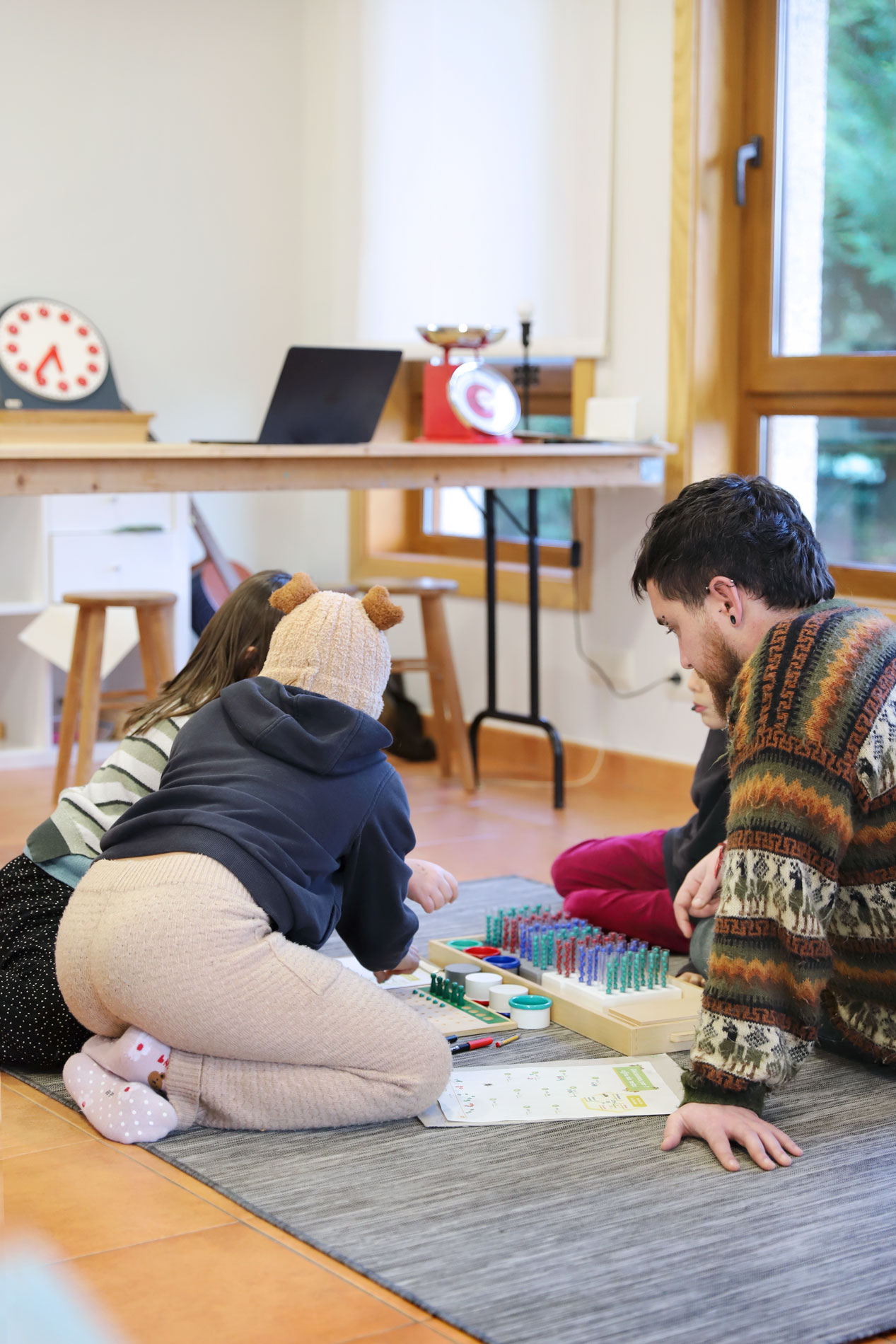
Whole-person development, each at their own pace. An active school inspired by Montessori: independent work in carefully prepared learning environments that spark wonder, small and stable communities with a reference tutor, and a ratio that allows truly individual attention. The adult educator guides, rather than transmits.
Trilingual, with English as the main language. The three languages live together naturally, without giving up abstract and logical thinking.
Nature is a classroom. A rural setting, a vegetable garden and Aula Natura Fridays at the beach, in the forest and by the river: experiential learning is not a field trip, it is part of the method. Being aware of what surrounds me helps me get to know myself.
Focus on the process, with structure and evidence. We teach how to learn to learn (we look at processes, not only results) within a clear framework: an official reference curriculum and international accreditation (NEASC), Cosmic Education as the backbone of our projects, daily mathematics and literacy, and assessment that accompanies without ranking.
A community, not a business. An independent project, small by design (~60 families), sustained by conviction, where families are part of the project, not clients. The end goal is not a grade: it is for every child to discover who they are and build a full life, with its lights and its shadows.
What Gándara is NOT
It is not a school that buys results at the cost of wellbeing: neither English, nor accreditation, nor any metric comes before a child's emotional safety.
It is not a "free" school without a framework: freedom, not licence: there are routines, a curriculum, goals and assessment, and limits are set with love because they are also care. Caring does not mean avoiding all frustration.
It is not an orthodox certified Montessori school: Montessori is our methodological inspiration, combined with an international curriculum and our own decisions. We do not sell AMI purity.
It is not a British school or an English academy: English is a vehicle for learning, not an advertising claim; we do not promise instant bilingualism, we promise measured progression.
It is not a play centre in the woods: the experiential has rigour behind it: teaching programmes, assessment checkpoints and external accreditation.
It is not traditional schooling: no textbooks as the backbone, no systematic homework, no number grades or rankings.
The words of Gándara
These are the words you will hear (and that your children already use), and what they mean to us:
Educator. The adult who prepares the environment, presents materials, observes and accompanies. We do not say "teacher" (and if you do, that is fine): the name tells the role. Their intervention gradually steps back as each child gains autonomy.
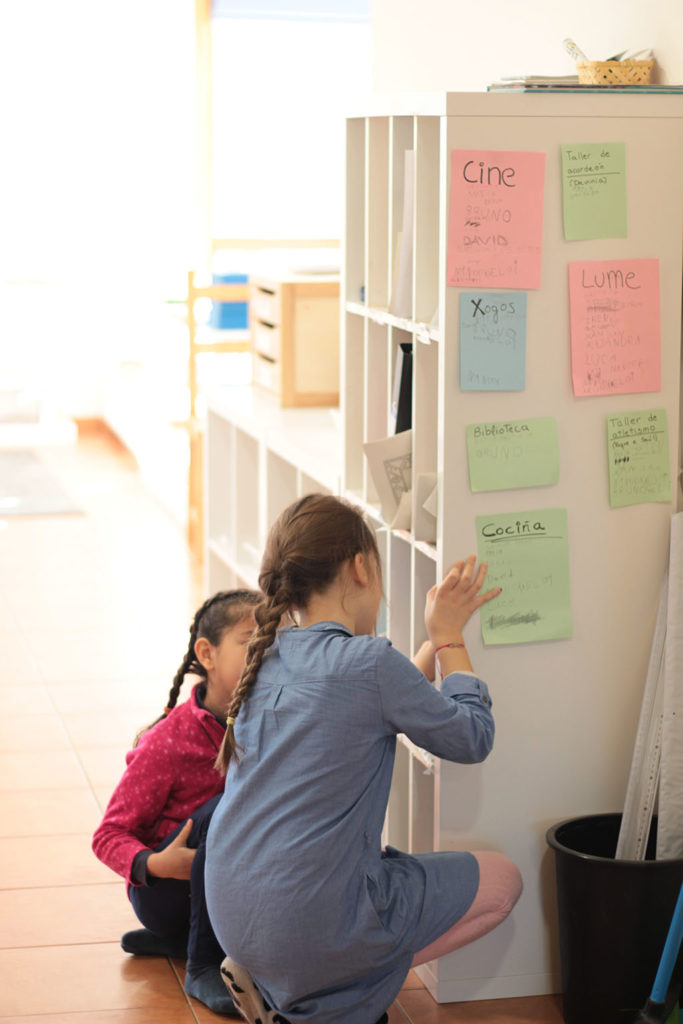
Learning environment. We do not say "classroom": a learning environment is a space prepared with intention (order, beauty, accessible materials) so that independent work is possible. Caring for it is everyone's job, children included.
Independent work. The central part of the day: each child manages their own work among the materials and proposals they already have access to, at their own pace and level. It is not free play, nor "everyone on their own": there is a framework, a purpose and a constant, discreet adult presence.
Freedom and access. At Gándara freedom is not the starting point: it is a conquest. It grows as each child shows autonomy and care for the materials, the environment and other people. Freedom with responsibility, never licence.
Agreements and limits. Agreements are the shared rules of living together that each group builds: few, clear and stated in the positive. Limits are the non-negotiable boundaries that protect physical and emotional safety; the adult team holds them with love and with firmness.
Proposal, challenge, project. Three ways of working: a proposal is offered and can be taken up or not; a challenge is accepted and commits you (it has a visible goal); a project is sustained over time and usually ends in something that is presented. Proposals are born from observing each child, not from a syllabus.
Paper: worksheets, notebooks, portfolios. Experience comes first: children learn by doing, with concrete materials, progressively moving towards the abstract. Paper comes afterwards, to record, organise and consolidate what was lived; and in the last cycle writing deliberately gains weight.
Assessment and supportive data. No graded exams, no rankings. We record evidence of real learning and hold assessment checkpoints with shared criteria, to guide support and celebrate progress, never to label or compare.
Aula Natura. The Friday when the whole school learns together at the beach, in the forest or by the river. With its safety framework behind it, like everything experiential at Gándara.
Community. Each stable group of children with their educators is a community; and all together (children, families and team) we are the school community.
Montessori inspiration underpins all of this: prepared environments, concrete materials, mixed ages and deep respect for childhood rhythms, combined with an international curriculum and our own decisions.
Our Space
Gándara is located in a privileged environment that combines nature and proximity to the urban center of Vigo.
Our facilities are specifically designed to facilitate Montessori learning, with bright, orderly spaces adapted to children's needs.
Each classroom is a prepared environment where materials are organized logically and accessibly, inviting autonomous activity and discovery.
A property of more than 5,000 m² with extensive green areas, a school garden, and outdoor play areas
Welcoming indoor spaces with high-quality Montessori materials
Strategic location: 10 minutes from the center of Vigo with easy access from the AP-9
Montessori Classrooms
Our prepared environments are designed to foster autonomy, exploration, and active learning at each stage of development.
Early Years (Ages 3-6)
In the early years stage, children work in a prepared environment with Montessori materials that invite sensory exploration, language development, and early mathematical concepts.
The early years classroom is a bright, orderly space where each material has its place. Children freely choose their activities and work at their own pace, accompanied by guides trained in Montessori methodology.
Primary (Ages 6-12)
The primary stage is divided into two cycles: Workshop 1 (ages 6-9) and Workshop 2 (ages 9-12). Children work on interdisciplinary projects that connect areas of knowledge and encourage research.
In primary, learning extends beyond the classroom. Research projects, outings to the natural environment, and cooperative work form the basis of our educational approach.
Nature and Active Learning
At Gándara, nature is not just a setting: it is a pedagogical tool. Our more than 5,000 m² property offers a vegetable garden, gardens, and green spaces where children learn natural sciences through hands-on experience, develop motor skills, and connect with the cycles of life.
Ready to meet us?
Take the next step and discover how we can accompany your child in their learning journey.